
It’s high time and truly in every way for every generation of Bharata Desa to know, learn,and be aware of the heterogenous cultures and sub cultures that exist and thrive in this continent. And while Abrahamic religions focus on the Male, the alpha, the son of Gods and only ONE GOD. We have diverse dieties, vigrahas,devatas and devis that gives us a connection to our land, keeps us rooted and grounded, an identity that comforts us.
The temple of Srivilliputhur, 80 kms away from the famous Madurai in Tamil Nadu is one of the 108 Divyadesams ( Divine abode) dedicated to Shree Vishnu and it’s beautiful, magnificent goddess Andal.
Andal’s story is a mix of myth and faith, legend, belief and ‘itihaasa’ is intertwined completely and what remains is personal faith and a devotee’s intimacy with the goddess.
The goddess captured my attention for many reasons. Quoting from Archana Venkatasan about Hindu iconography, ‘ One has to study the context of Hinduism broadly, particularly within the Sri Vaishnava tradition where it was understood that the image is fully and completely GOD. It is an embodied powerful fully functioning deity’.
This sums up Hindusim. The deity,the vigraha, the image is devata/devi, a fully functioning God or Goddess that dispels the inner darkness in humans when they reach out to them, the deity gives them a renewed sense of life, purifying everything that is impure, external and within when they walk into the Garba Griha.
South Indian temple traditions and rituals are vast and varied. And in the case of Andal, she is not only a Goddess, she is the daughter of Srivilliputtur, she is intrinsic to the lives of the people and community there.
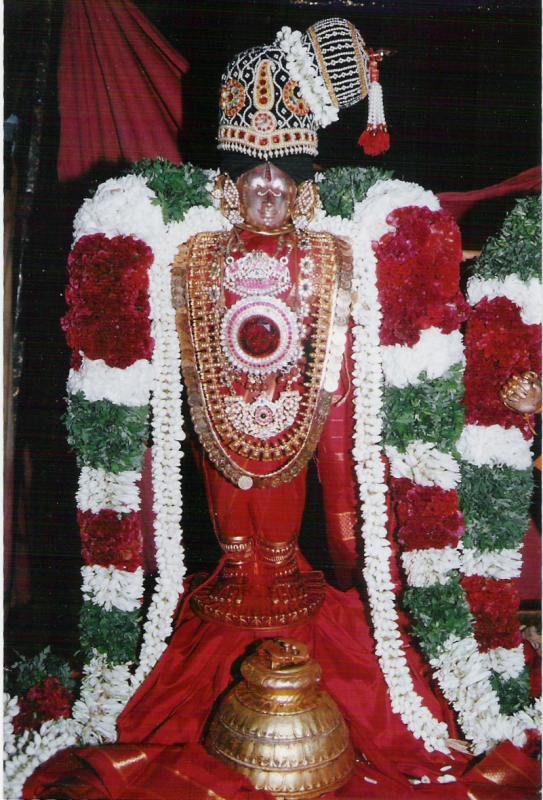
The imagery of Andal/Kotai is fascinating, for I feel no other Goddess has been represented visually this way. When one looks at her, there is an instant connection to her, here is a woman, a poet, a goddess that merged with the divine through pure love and devotion and at the same time retained her identity. She is independent and she is most revered even above Vatapatrasayi – Lord Krishna and this element is unique in nature.
In the pantheon of gods that exist in Hinduism, there have been temples dedicated to Goddesses both in mainstream Hinduism and in local cultures based on local communities. Andal is unique as she combines the above beautifully. While mainstream Hinduism sees her as a Goddess, the local community sees her also as a poet, as a saint, their daughter who existed amidst them, she is one among them.
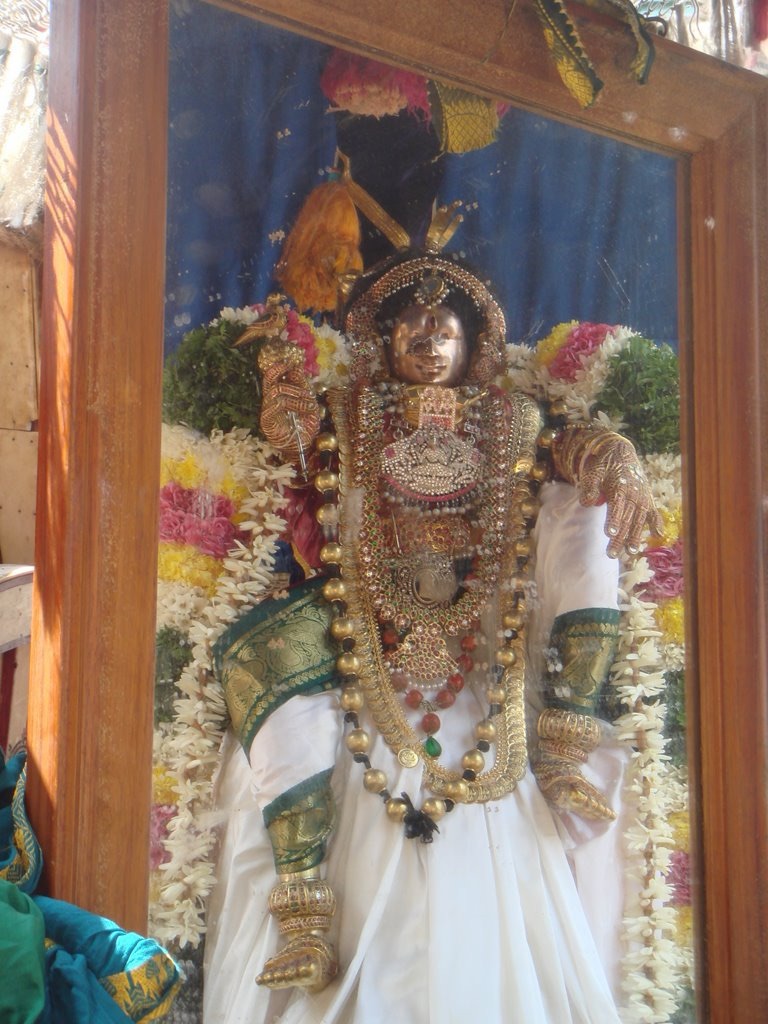
What is stunning is her Alankara (ornament and decoration). Her style of hair in a bun was very common among the Namboodiri(Kerala Brahmin) community in the state of Kerala. That was the first thing that caught my attention. Was there a connection with Andal that went beyond Srivilliputhur?
She is very much the bride with the huge wedding garland that is synonymous with south Indian traditional wedding rituals. She has a smile yet coy, and confident as she waits for her husband, Sri Rangamannar, for the exchange of garlands. The Nithyakalyana Roopa – The Eternal bride at once captures the imagination of the devotee as he/she walks into the Garba Griha.
It is not merely “Darshanam” ( auspicious sight of a deity) , it is beholding the image with all senses awakened, enhanced as one witnesses this divine image of the Goddess as she is, it is not a representation, but it is her in every way. The ritual of the garland every day, as it is sent to the Vatapatrashayi is significant as it reminds the community and all her devotees that this scene will be enacted time and again over centuries, a reminder for generations to come that faith and belief will continue to exist beyond time and space.
For the devotees of Andal and for all following Santana Dharma in its truest form, there is no concept of myth, there is only ‘truth’ which is, she was born in Srivillipthur, the daughter of the town that came home as a bride with Sri Rangamannar and made him reside next to her for eternity.
The lotus she holds in her hand shows she is also Sri/ Lakshmi Devi, the consort of Vishnu, the lotus symbolises self liberation, prosperity and knowledge. The parrot that sits on the hand of Andal signifies some interesting stories.
Parrots have been known for generations in South India to predict the future. In fact they are seen as carrying the messages of Gods. In the context of Srivilliputhur, it could mean that Andal was sending messages to her beloved Krishna through the parrot, that could be one of the interpretations of having the parrot in the image.We see that with Madurai Meenakshi, with Radha in Brindavan.
There also has been a deep connection of the Brahmin community with the parrots. It was known that the parrots repeated the Vedas chanted by the Brahmin priests. Gods and Goddesses in Hinduism have a strong connection with birds. Whether it was Andal, Meenakshi of Madurai with the parrot, Saraswati Devi with the Swan, Lakshmi Devi with the owl, Vishnu with his Vahana – Garuda, Skanda/Karthikeya with the rooster.
The deep connection with nature and its varied creations is wholly experienced in Hinduism.
Andal is the mystic bride and she is given such an importance that every Vaishnavaite temple has a sanctum(Sannidhi) for her.
The era that Andal lived in was the period of Tamil Vaishnavism ( 5th – 9th century CE) with the 12 Alvar Saints and Andal being the only female poet/saint among them. Though her existence has been obliterated in the texts written during that time, during the Bhakti movement, what remains is her poems “Tiruppavai” and “Nacciyar Tirumoli” and these two did occupy a prominent place in the rituals and religious beliefs in that era and it continues to do so. She does resurface as a Goddess in the mid sixteenth century, with songs of devotion composed on her, and with temples built in her honour.
I quote this translated verse from Archana Venkatesan’s ‘ The Secret Garland’ that gives an insight into the devotion, passion and love Andal expresses in her poem. This translation is from one of the verses of Tiruppavai.
Mayanai Mannu
O enigmatic Mayan
King of eternal Mathura of the North
Lord who plays
By the great unsullied waters of the Yamuna
Radiant beacon
Of the cowherd clan,
Damodara
who brightened his mother’s womb,
We are pure
With these fresh flowers
We come to you
We sing of you
We think of you
let all our past misdeeds
even those still to come
burn
turn to ash
sing of him
There is also another image of Andal as a warrior, a Queen that reigns over her land and this image particularly captured my imagination. This seated posture is regal, she is the ultimate sovereign that protects her people, her land.
Very much in her bridal finery she sits in the Garba Griha with her beloved lord Sri Rangamannar. The various festivals conducted in the temple, especially the 10 day festival in the month of Margazhi( brahma muhurtham- auspicious) particularly is noteworthy. Unlike other temples where the processions are of the Goddesses with the Gods, there are certain days when she takes on the role of Vatapatrashayi, one day as Vishnu, one day as Krishna, one day as Azhagar. This also denotes the Goddess, the Queen seeing Srivilliputhur as her fortress. This is Andal’s fortress.
Equally fascinating is the parrot in her hand. Every day the parrot is woven and hand made by a community of parrot makers – Sathada Sri Vaishnava family. This parrot is made of flowers and leaves and takes 3-4 hours every day and is given as an offering to Andal. These parrots are made only on two other occasions, to Azaghar temple in Madurai during the festival of Chitra Thiruvizha in the month of April, and to Sri Venkateshwara Swamy temple in Tirupati during Brahmotsavam in September.
Also fascinating were the similarities between Andal and Meenakshi of Madurai, though one belonged to Vaishnava sect and the other to the Saiva, there is an interplay and communication between the two sects.
The Goddesses mirroring each other with their bridal finery, the hair bun, the parrot, with the seated posture of the sovereign is uncanny and just as Andal emerged from the earth, Meenakshi arose from the fire, married Lord Shiva as Sundareshwara and ruled over the kingdom until they merged into the temple.
Stories like these communicate the intricate networks the communities had with the temples and how these stories could contextually be rewritten to suit the times. It also linked the Royal Sovereign to divinity, the king and Queen were equivalent to the Gods and Goddesses residing in the temples.
The processional festivals in Srivilliputhur and Madurai are similar and the common connection between them is the King Thirumalai Nayaka from the Nayaka dynasty. He was an ardent devotee of both the Goddesses and that also shows the communication the two temples had with each other. This could have highly influenced the respective temple calendars when it came to processions and rituals.
The Kondai (hair style) stands out adorned by a crown and her hair is in a bun with an elaborate plaited hair. It is to be noted that to the present day, the bride in the Vaishnava Brahmin sect continues to wear the ‘Andal Kondai’.
Re-enacting the event of wearing the garland of Vishnu and looking at herself in the mirror is ritually and beautifully observed as the head priest shows her the mirror so she can admire her beauty. This as a whole summarises the strong bond of the people and devotees of Srivilliputhur to the Goddess. She is a living breathing Goddess, granting their wishes, alleviating their suffering.
The image of Andal is in the sanctum right next to Vatapatrashayi(Vishnu in reclining posture) and Garuda is also a part of the sanctum for he is the father-in-law/vehicle who got Sri Ranganatha to Srivilliputhur. It is important to note that Garuda is next to the main deities as opposed to other temples where he is standing opposite to Lord Vishnu.
One important note about the festivals in the temple is the very significant ‘Araiyar Sevai’, ( service) it is a visual song and dance enacting the Divya Prabhandam ( devotional hymns) that has 4000 verses. This has been performed in the Divya Desams for over 1000 years. Srivilliputhur is one among the three Divya Desams that continues to perform Araiyar Sevai , the other two are Srirangam and Azhvar Tirunagari near Tirunelveli in Tamil Nadu.
‘Araiyars’ are known as Kings of Music and are said to be the descendants of Narada Muni and it is believed that Sri Ranganatha himself gave the Araiyars the right to perform at the temples. It is not an easy art and it takes nearly 20 years to learn and perfect the abhinayam.
The Alankara of the Goddess, in her many forms, the daily ritual of the wedding garland, the processional festivals in her honour where she is above all the Gods, looking over and protecting her people, and her interchanging roles from being Kotai the girl, the poet and devotee from Srivilliputhur to becoming Andal- she who rules is truly immersive in every way.
The intense love that Andal feels for her beloved Krishna is Bhakti, ( devotion) pure Bhakti, her poems cut across all barriers of caste and creed, she embodies the love for her beloved in her poems.
She is an extraordinary Goddess in the religious history of Hinduism that showed her people a path to reach the divine, the importance of taking everyone along when one goes to worship.



 Nyssa - The Beginning